The usual gas welding techniques in Oxy-acetylene welding are as follows:
1.Leftward or fore-hand welding:- In this method, the welding torch is held in the operator’s right hand, the tip pointing towards the left and the weld is made from right to left. The torch makes an angle of 60°- 70° with the plate and the welding rod makes an angle of 30° - 40°. The plates above 6 mm thickness are not economical to weld with this method.
2.Right-ward or back-hand welding:- In this method, the welding torch is held in the right hand and the filler rod in the left-hand. The welding begins at the left hand end of the joint and proceeds towards the right. The torch makes an angle of 40° - 50° with the plate and the welding rod makes an angle of 30° - 40°. This method is better and economical for plates over 6 mm thickness.
3.Vertical welding:- The vertical welding may be carried out either by the left-ward technique or by the right-ward technique. The great advantage of vertical welding is that the plate edge preparation is not required up-to 16 mm thickness.
4.Linde welding:-It is a special welding technique in which the use of Oxy-acetylene flame with excess acetylene is made and the right-ward technique is used.
136) In fore-hand welding, the weld is made
Answer is:
from right to left
Explanation:
Related Workshop Technology MCQ with Answers
Answer is:
vertical
Explanation:
In vertical welding, the weld may be made either from left to right or from right to left.
Answer is:
black color
Explanation:
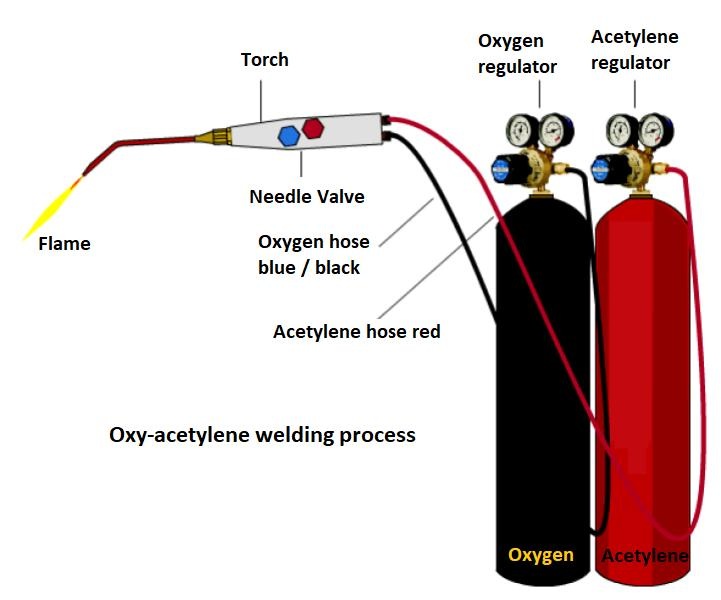
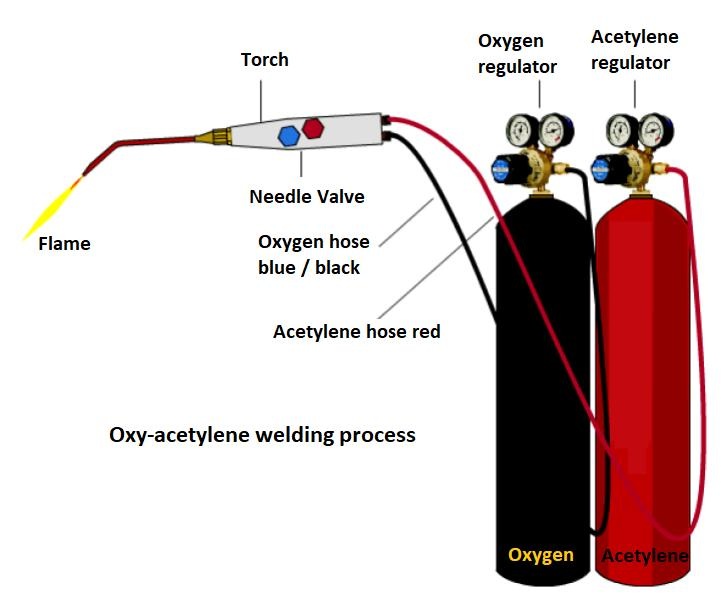
The oxygen cylinder is usually painted with Black colour.
Answer is:
maroon color
Explanation:
The acetylene cylinder is usually painted with Maroon colour
An acetylene cylinder has a different design from most other gas cylinders. It consists of a steel shell containing a porous mass. The acetylene gas in the cylinder is dissolved in acetone which is absorbed by the porous mass.
Answer is:
more
Explanation:
In forehand welding, the angle between the welding torch and the work is More as compared to backhand welding.